Global Data Centre Energy Demand Set to Triple by 2030 as AI Fuels Infrastructure Boom
Mainframe in a row, network security design warehouse generated by artificial intelligence
The rapid growth of artificial intelligence, cloud computing and digital services is expected to drive a dramatic increase in global data centre energy consumption over the remainder of the decade, according to new analysis from GlobalData.
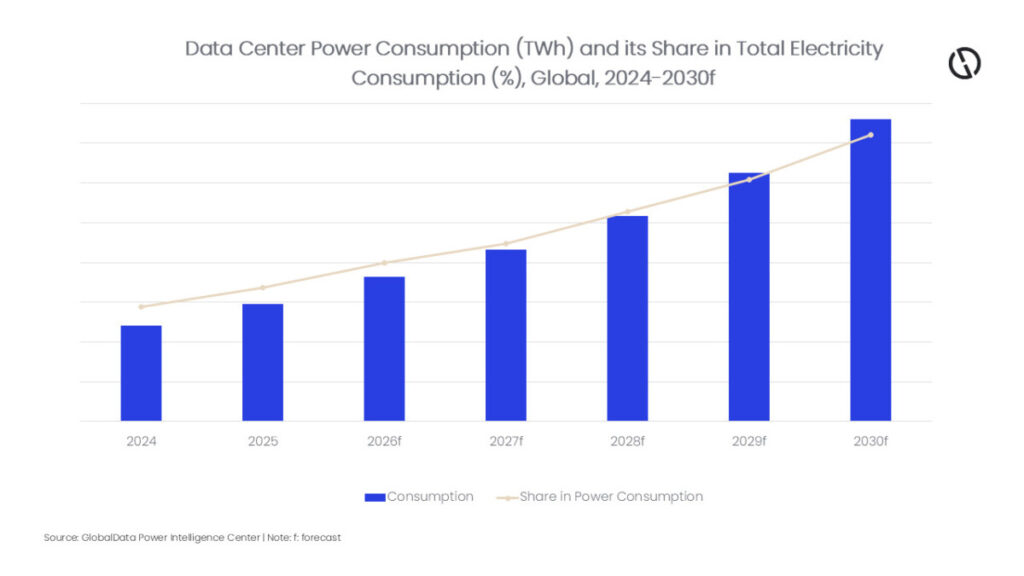
The intelligence and analytics firm forecasts that electricity demand from data centres will almost triple between 2024 and 2030, growing at a compound annual growth rate (CAGR) of 21.1%. The surge reflects increasing reliance on cloud platforms, expanding digital infrastructure, and the growing computational demands of AI technologies.
Data centres, once viewed primarily as back-office IT facilities, are increasingly becoming critical infrastructure underpinning modern economies. Businesses, governments and consumers are generating unprecedented volumes of data, while AI applications require vast amounts of processing power, particularly through high-density graphics processing units (GPUs).
According to GlobalData’s latest report, “Powering Data Centers Market Report: Power Consumption, Capacity, PUE and Project Pipeline Analysis and Country Ranking Forecast to 2030,” the United States and China currently dominate the sector. In 2024, the two countries accounted for 38% and 24.2% respectively of global data centre power consumption.
However, the balance of power is expected to shift significantly by the end of the decade. China is forecast to overtake the United States, accounting for approximately 30.1% of global consumption by 2030 and continuing to rise towards 33.6% thereafter.
 Rehaan Shiledar, Power Analyst at GlobalData, said:
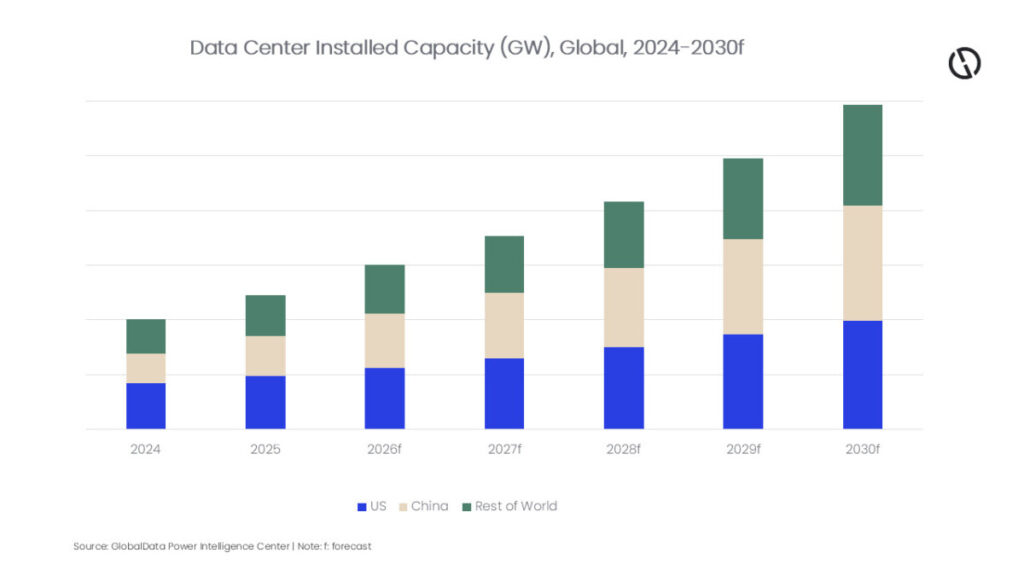
“The global data center installed capacity is projected to surge by 2030, delivering nearly a threefold expansion within just six years. China is expected to lead this growth engine, scaling from 27% in 2024 to 35% by 2030. While the US is projected to remain the second-largest market, currently at 42%, its share is expected to decline to 34% by 2030. Even in 2030, China and the US together account for about 69% of the market, implying that global data center capacity will remain heavily concentrated in two geographies.”
While China and the United States continue to dominate, significant investment is also taking place across the Asia-Pacific region. Countries including India, Japan, South Korea, Australia and Russia are expanding their data centre footprints as digitalisation accelerates and cloud adoption becomes increasingly widespread.
GlobalData expects installed data centre capacity outside China and the United States to remain relatively stable at around 31% of the global total through to 2030. Nevertheless, project pipelines remain substantial across many emerging and developed markets, with facilities moving through planning, permitting, construction and commissioning stages.
The structure of the market is also evolving. Hyperscale operators such as Microsoft Azure, Amazon Web Services (AWS), Google Cloud and Meta continue to drive demand, while colocation providers are expanding to support businesses seeking flexible, ready-made infrastructure.
 Shiledar said:
“The global data center market is set to be shaped predominantly by hyperscalers, colocation and managed service providers, and enterprises, because each segment addresses a distinct and enduring set of requirements. Hyperscalers will remain the principal engine of growth as AI training, inference, and cloud-native workloads require vast increments of capacity delivered with industrial speed, extreme efficiency, and tight integration across compute, storage, and networking. Colocation and service providers will expand in parallel by supplying ‘ready-to-use’ power and space, dense interconnection ecosystems, and flexible commercial structures.”
The United States remains the world’s largest hub for both hyperscale and colocation developments. GlobalData estimates that around 78.2% of the country’s future pipeline will consist of hyperscale facilities, compared with 21.5% dedicated to colocation.
The UK presents a different picture, with a stronger emphasis on colocation infrastructure. Approximately 61.2% of planned UK projects are expected to be colocation facilities, while 38.8% will be hyperscale developments.
Government policy is also playing a growing role in shaping investment decisions. Countries are increasingly introducing measures aimed at strengthening digital infrastructure, promoting sustainability and ensuring data sovereignty.
Recent examples include a US Executive Order aimed at accelerating federal permitting for large-scale data centre projects, China’s strategy to encourage development in western regions where renewable energy resources are more abundant, and India’s continued use of tax incentives and policy support to attract investment into the sector.
As the scale of data centre development increases, so too does its impact on national electricity networks.
Shiledar concluded:
“Data centers are rapidly reshaping the power sector. Fueled by the acceleration of AI and cloud computing, global electricity demand from data centers has surged. With a single hyperscale facility capable of drawing as much power as a small city, this growth is forcing consequential shifts across generation capacity, transmission and distribution investment, and day-to-day grid operations.”
The findings highlight the growing challenge facing governments, energy providers and technology companies as they seek to balance digital growth with energy security and sustainability objectives. With AI adoption accelerating worldwide, the race to build the infrastructure that powers the digital economy shows little sign of slowing.
—
Image: Magnific.com